
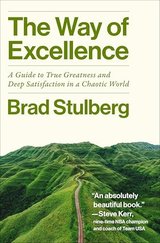
The Way of Excellence
← Back to Reading List | View Amazon for details and reviews
Summary
A formula for how to do hard things and how to do them well. It focuses on the importance of enjoying the process of mastering something long-term and difficult. Learning to develop difficult skills and making progress in activities that are important to you is the key to life satisfaction.
Notes and Quotes
We are at our best when we are: Working without distraction on something that matters to us. Creating and contributing to the world. Engaging deeply with others. Sufficiently challenged. Using our unique skills. In a state of relaxed productivity. Giving something our all. In the presence of beauty.
Author's definition of excellence (bolds mine):
Excellence combines mastery and mattering. Mastery means developing skill and making progress in activities you deem worthwhile. It could result from learning a trade or advancing in a career, but it could also come from increasing the weight of your deadlift, writing poetry, building a table, making art, or learning how to play an instrument. Mattering is a sense that what you are doing has significance, that your contributions and progress are meaningful. Decades of research show mastery and mattering are key to a life well lived, or what psychologists call life satisfaction.
Part 1 - Theory of Excellence
A model of human development called the four phases of competence does a nice job outlining how progress unfolds in nearly any endeavor. 1. Unconscious incompetence - you don't know what you are doing and you don't know that you don't know. 2. Conscious incompetence - you know you are bad and making mistakes at what you are doing 3. Conscious competence - you are doing your activity correctly but having to make an effort 4. Unconscious competence - You do not have to think while doing your activity. You are acting on feeling.
To be truly competent at something, you have to be able to do it without thinking.
A profound example of unconscious competence comes from the three-time Grammy winner and international superstar violinist Hilary Hahn. When she described her experience onstage as a soloist, often playing in front of thousands of people, she told me she feels her way forward. “It’s not really a thing I’m thinking about. I’m not thinking, Oh, I should think about the accuracy of this particular passage, or Oh, how am I going to vibrate this note to make this effect? If I start thinking about that onstage using words instead of feelings, I’m already way behind in the music. It really is that you have to be completely in the note and not behind yourself or ahead of yourself because you’ll miss the moment, you’ll overlook all these things that are really interesting that are happening too fast for thinking.” It’s not just Hahn. As you’ll see in the coming pages, all of us can benefit from getting in touch with the feeling of excellence.
Research shows that the best way to learn something is to feel what it’s like to do it incorrectly and correctly. You feel the perfect golf swing, swim stroke, running stride, or tennis serve. You feel the keys on the piano or the strings on the guitar.
We are what we do. And what we do should align with our values so that what we are doing aids growing into the type of person we want to be.
Yes, you can burn out from doing too much. But you can also burn out from not doing enough of what lights you up.
Part 2 - Core Factors of Excellence
Chapter 4: Care
Excellence requires intimacy:
It requires minimizing distractions and getting as close as possible to your pursuit. It’s being in the pocket of a deadlift, song, or painting; it’s being immersed in developing an idea, leading a team, or learning a new skill.
You get satisfaction only when you develop a skill and do something well. If you don’t have a way to objectively measure how well you are doing, you will be unsatisfied.
You can possess all the knowledge and talent in the world, but it doesn’t matter if you don’t care. Caring drives everything, regardless of what it is you do.
Once you find something you care about, you then focus on do that thing well, even through all of its high and low moments. Determine fit first, then focus on grit.
You can't make a single pursuit your whole identity - you have to have a strong sense of self separate from your activity. You have to be willing to fail, and if you only identify as your pursuit, you will play to not lose instead of play to win (and occasionally fail).
Chapter 5: Goals
Your goal may be to climb a mountain, but you will spend most of your time climbing its sides. You can't only live for that future state - you have to live for the process of getting there.
There is no greater illusion than thinking the accomplishment of some goal will change your life. What will change your life is how you are transformed in the process of going for it. When you select what goals to pursue, you are selecting what kind of person you want to become.
You have to pick goals that stretch you but aren't too hard. They also can't be so easy that you get bored. You cant rush to accomplish your goal because you can make mistakes and fail.
Research shows that athletes who are overly fixated on achieving their goals overtrain and get injured. Creatives who are obsessed with achieving their goals don’t take appropriate time for rest, recovery, and renewal—the elements that can fuel breakthrough ideas. In more traditional workplaces, being obsessed with accomplishing goals often leads to burnout or worse.
We cannot control how someone receives our work, the weather on race day, the judge’s mood during a competition, or all manner of other factors that impact outcomes, in work and life. Sometimes we do everything right and the outcome still doesn’t go our way, even in spite of our deepest desires. All we can control is our process.
A process-over-outcomes mindset is essential for excellence. Here’s how it works: Set a goal. Figure out the discrete steps to achieving that goal that are within your control. Mostly forget about the goal and focus on executing the steps instead. Judge yourself based on the level of presence and effort you are exerting in each moment. If you catch yourself obsessing about the goal, use that as a cue to ask yourself what you could be doing right now to help you move forward. Sometimes the answer may be nothing at all. In that case, rest. Whether you succeed or fail, learn from the outcome, refine your process if necessary, and move forward.
The ultimate way to embrace a process-over-outcomes mindset is to stop worrying about being the best and instead focus on being the best at getting better. Being the best is a flash in time. You get there or you don’t. Either way, it comes and then it goes. But being the best at getting better—that’s a commitment to mastery that lasts a lifetime.
Chapter 6: Consistency
Making small regular progress towards something is how you achieve big goals. They don't happen overnight.
Doing something consistently ensures you make progress towards your goals regardless if you are motivated or not.
Remember that what you do on your bad days may be more important than what you do on your good ones.
Worry less about heroic days and more about creating a heroic body of work.
Nobody can be consistently great, but you can become great at consistency.
It is easy to focus when you are motivated, at your best, and everything is clicking. It is harder to focus when you are feeling off and as if you are moving against the current. But what you do on your not-so-great days may be most critical of all. Nothing brings down an average like a zero—it’s basic math. So you want to avoid zeros whenever you can. Herein lies an idea called raising the floor, which entails making your bad days just a little better.
What’s true in golf is true in life. Each and every one of us will face setbacks, unforced errors, and moments when our emotions flare and our plans fall apart. What matters most is how we respond—again and again and again. It’s called having a next-play mentality, and it’s a central feature of consistency.
When our North Star is consistency, we adopt a short memory, which ironically is key to playing the long game. We forget about what happened on a great shot or day and get back to work. We forget about what happened on a bad shot or day and get back to work.
Chapter 7: Trade-Offs
You need to learn to focus on what is most important to you - you can't be great at everything. At the same time, you can't obsess only on one aspect of your life, otherwise your other important parts (other "rooms of your house") will suffer.
Two concepts can help. The first is establishing a minimum effective dose: the amount of time necessary to stay connected to each of the central rooms in your identity house. It’s okay to spend a disproportionate amount of time in one room, so long as you don’t let others get moldy. It’s also okay to let go of certain activities, so long as they aren’t integral to who you are or wish to become.
When we are wholly immersed in a particular activity—whether it’s sport, art, business, or something else—it’s all too easy to let the inertia of the experience carry us forward without stopping to evaluate what we’re sacrificing along the way. It’s how people destroy their health, lose their relationships, and burn out.
The way you improve in anything is by eliminating distractions, prioritizing the fundamentals, and executing them with ruthless consistency.
Keep the main things the main things.
Make sure to show up and do the simple 99.9% instead of hyper focusing on the complex last .1%
Chapter 8: Focus
There is an ongoing battle between algorithmic mass distraction and focus. Excellence requires winning it.
The quality of your attention shapes the quality of your life.
It is impossible to truly multitask. You have to learn to build focus and work on the most important one thing at a time.
When we multitask, we do (and nowadays also consume) multiple things at once. Sometimes we multitask voluntarily. Other times, we multitask due to frequent interruptions that we didn’t ask for. Often it’s a combination of the two. Multitasking makes us feel productive because we believe that we are accomplishing twice as much.
Even in individuals who claim to be great multitaskers, fMRI scans of the brain reveal it is impossible to do two things at once with a high level of quality. What is happening when we think we are multitasking is that our brain is either constantly switching between tasks or it is dividing and conquering, allotting only a portion of our cognitive capacity to any specific activity. According to countless studies, the consequence of multitasking is that the quality and, ironically, even the quantity of our work suffers.
Even if it is not our own, the mere sight of a smartphone has come to signify everything else that could be happening in the world. Just being in its presence is a powerful source of distraction.
Once you have done good deep focused work and you start getting stuck or making mistakes, it's important to take a break to be able to restore attention.
Chapter 9: Discipline
There are times when you are going to feel very motivated, and that’s great. But discipline is doing the things you need to do, regardless of how you feel about them.
We think we need to feel good to get going, but often the opposite is true: We need to get going to give ourselves a chance at feeling good.
Your emotions can change on a dime and often not for any good reason. It takes self-reflection to sit with emotions and ask whether or not they are reflecting truth or something else—before acting on them. But many people believe that just because they feel something, it must be the same thing as truth.
When you are unmotivated, you have to start doing a task, anything, small. Getting started on something will improve your chances to feel good and prime you to get done what you need to get done.
You don't need to feel good to get going; you need to get going to give yourself a chance to feel good.
Kipchoge says, "Only the disciplined ones in life are free. When you are undisciplined, you are a slave to your moods and passions."
Chapter 10: Renewal
Rest and renewal do not come at the expense of your primary pursuit; they are integral parts of your primary pursuit and your commitment to excellence.
Our muscles get bigger not when we are training but rather during periods of recovery between workouts. It is only then that the body adapts to the strain that was placed on it, growing stronger as a result. The same is true for our brains. It's why so many creative thoughts, breakthrough ideas, and aha moments occur not when we are actively working on an important task but during breaks—while walking, showering, driving, cooking, cleaning, or just upon waking.
Chapter 11: Confidence
The faith required for excellence is not blind or delusional; it is acquired.
You gain confidence by continually doing hard things, breaking through challenges, and making progress towards large goals.
Chapter 12: Patience
Patience is something you need to practice to improve at. Learning to be patient is the only way to be excellent in long term goals.
Not having our phones during short periods of waiting may seem trivial, but it helps decondition our habituation to novelty and speed. This carries over into larger areas of life. If we can unwind our dependence on stimulation, if we can get comfortable with open and liminal spaces, then we can make more intentional decisions about when to move fast and shake things up versus when to slow down and stay the course.
You need the patience to keep producing and not give up. Eventually you will have a lucky break.
"Quality is a probabilistic function of quantity," says one such study's author, the psychologist Dean Keith Simonton. In other words, the more we produce, the better we become.
Excellence is not about being a champion of one inning. It's about playing all nine as best we can.
The longer we stay in the game, the more our surface area for luck increases.
Chapter 13: Routine
Routines prime you for doing what needs to get done. Be thoughtful about creating routines that align with your goals.
Another powerful way to think about routines is to develop daily, weekly, and monthly practices. These become foundational elements of our lives that prime us for excellence. Rather than trying to concoct elaborate routines with nineteen components—and in the process, generating more stress rather than alleviating it—we can simplify and focus on what matters most. We can name the main things and keep them the main things.
My three daily practices are forty-five to ninety minutes of physical activity, at least one block of deep-focus work on a meaningful project, and not fighting evening sleepiness, which usually means going to bed before 10:00 p.m. My three weekly practices are at least two long walks outdoors, gathering with friends at least once, and spending one day completely offline (a digital sabbath). My three monthly practices are at least one chunk of meditation, contemplation, listening to music, or some other form of deliberate reflection on who I am and why I'm here; at least one day when I'm predominantly outdoors; and at least one outing when I'm involved with my local community.
- The first rule of routines is to develop them and do everything you can to uphold them.
- The second rule of routines is to release from them when life demands it.
- The third rule of routines is not to let rule 2 become a chronic excuse for rule 1.
Chapter 14: Gumption
Figure out what the easy "wins" for your activity are so you can do them regularly to build confidence and avoid slumps of constant losses.
[Gumption is] a feeling that no obstacle can stop you.
When a player is slumping in basketball—whether it's missing shots he normally makes or turning the ball over and becoming frustrated—the best thing is to take a layup or get to the free throw line. Both are high-percentage shots for most skilled players. When you make a layup or free throw, you put points on the board and see the ball go through the net. You regain a little confidence and feel for the game, which makes it easier to leave the slump behind.
Chapter 15: Curiosity
Curiosity outlasts the desire to win or lose. It also helps you stay in the zone since you are not fight or flight responses. You can't be curious and fearful at the same time.
If we are stuck or stagnating, instead of doubling down on what we’ve been doing (or spiraling into rumination), we can get curious and identify our own variables to adjust. It could mean changing the cadence of our work, the tools we use, the tempo of the melody, or something else altogether. The deeper we get on our respective paths of excellence, the more important it becomes for us to stay curious and get comfortable running safe-to-fail experiments.
Another way to strengthen the habit of curiosity is by carrying an analog notebook with you when you engage in your craft, or keeping a diary or journal. When you come across something particularly interesting—perhaps an unforeseen challenge, an aha moment, or a new feeling or experience—jot it down. Even if you never revisit your notes, the act of writing down these observations helps to foster curiosity toward what you are encountering. Your pursuit of excellence becomes a field study, one in which you are both a participant and an ethnographer.
It’s best to be curious and explore feelings more deeply instead of immediately labeling and reacting to them.
Instead of trying to calm ourselves before consequential events, such as public speaking, it’s better to “reappraise pre-performance anxiety as excitement.” When we attempt to suppress pre-event nerves, we are inherently telling ourselves that something is wrong. Not only does this make the situation worse, but it also requires energy to fight the feeling of anxiety, energy that could be better spent on the task at hand.
Rather than trying to push away what we are feeling, we’re better off remaining curious and labeling our nerves as excitement. Doing so shifts us from a threat mindset (stressed and apprehensive) to an opportunity mindset (interested and ready to go).
Chapter 16: Failure
Failure sucks. It is also inevitable. Keep going.
It's ok to feel sad or sorry for yourself when failure happens. Take a short amount of time to feel that, then move on.
Chapter 17: Community
Belonging to a community helps you feel needed, and being with other folks pursuing the same goals is motivating.
A paradox of human nature is wanting to be unique and independent on the one hand, while wanting to belong and be enmeshed in something larger on the other. One way to resolve this paradox is by striving for our own version of greatness in a community of others.
Performance and motivation are contagious.
Prioritizing community may feel inefficient in the short term, but in the long term, it is one of the most efficient things there is.
Relying predominantly on negative emotions for energy is akin to burning dirty fuel: It’s destructive for the long-term health of the engine, and it’s not sustainable. Joy, on the other hand, is a clean and renewable source of energy. It builds upon itself and doesn’t leave toxic pollutants, such as resentment and isolation, in its wake.
Many soldiers are more satisfied at war than at home. This finding doesn’t make sense on its face, but Junger discovered that soldiers miss the strong sense of belonging and meaning they had at war. “Humans don’t mind hardship, in fact, they thrive on it,” he writes. “What they mind is not feeling necessary. Modern society has perfected the art of making people not feel necessary.”
Chapter 18: Joy
Joy prevents burnout, promotes longevity, and offers a wellspring of resilience.
Chapter 19: Completion
Every time we reach the top of a mountain, it’s important to pause and take stock of that particular ascent, knowing all the while that what comes next is yet another climb. By marking milestones and moments of completion, the broader journey, the one that never ends, becomes that much more satisfying.
When we don’t take time to pause and reflect, when we rush from one accomplishment to the next, we surrender gravity in both senses of the word: something that holds us to the path and something that enriches it with weight and significance.