
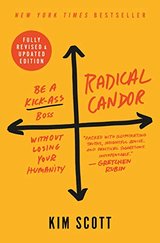
Radical Candor: Be a Kick-Ass Boss Without Losing Your Humanity
← Back to Reading List | View Amazon for details and reviews
Summary
The importance of tough conversations with coworkers and employees. How to be truthful to help others develop without being a jerk.
Notes and Quotes
Overview/Introduction
"The key insight behind Radical Candor is that command and control can hinder innovation and harm a team’s ability to improve the efficiency of routine work. Bosses and companies get better results when they voluntarily lay down unilateral power and encourage their teams and peers to hold them accountable, when they quit trying to control employees and focus instead on encouraging agency."
“Relationships are core to your job. If you think that you can [fulfill your responsibilities as a manager] without strong relationships, you are kidding yourself."
Compassion is empathy + action. Empathy on its own is often useless. If someone is stuck under a boulder - empathy means you feel the same crushing power of the rock and can't move to help them. Compassion is doing everything you can to make them feel better.
"It’s brutally hard to tell people when they are screwing up. You don’t want to hurt anyone’s feelings; that’s because you’re not a sadist" but "for every piece of subpar work you accept, for every missed deadline you let slip, you begin to feel resentment and then anger. You no longer just think the work is bad: you think the person is bad. This makes it harder to have an even-keeled conversation"
Build Radically Candid Relationships
"Andy Grove, Intel’s legendary CEO, asserts that management and leadership are like forehand and backhand. You have to be good at both to win."
"Ultimately, though, bosses are responsible for results. They achieve these results not by doing all the work themselves but by guiding the people on their teams. Bosses guide a team to achieve results."
Putting the emotional needs of your employees comes first. This may drain you, but this is a critical part of your job. It’s different from completions technical tasks, but equal if not more important.
"relationships are core to your job. They determine whether you can fulfill your three responsibilities [(guidance, team, results)] as a manager: 1) to create a culture of guidance (praise and criticism) that will keep everyone moving in the right direction; 2) to understand what motivates each person on your team well enough to avoid burnout or boredom and keep the team cohesive; and 3) to drive results collaboratively. If you think that you can do these things without strong relationships, you are kidding yourself."
"Former Secretary of State Colin Powell once remarked that being responsible sometimes means pissing people off"
"Challenging others and encouraging them to challenge you helps build trusting relationships because it shows 1) you care enough to point out both the things that aren’t going well and those that are and that 2) you are willing to admit when you’re wrong and that you are committed to fixing mistakes that you or others have made. "
Get, Give, and Encourage Guidance: Creating a culture of open communication
The meat of this book is the below framework. Your goal is to always be in the top right quadrant:
                    Care Personally
                              ▲
                              │
                              │
          Ruinous             │           Compassionate
          Empathy             │              Candor
                              │
                              │
◀─────────────────────────────┼─────────────────────────────▶
                              │                 Challenge Directly
                              │
        Manipulative          │            Obnoxious
        Insincerity           │            Aggression
                              │
                              │
                              ▼
[Care Personally] is about being more than “just professional.” It’s about giving a damn, sharing more than just your work self, and encouraging everyone who reports to you to do the same.
The second dimension involves telling people when their work isn’t good enough—and when it is; when they are not going to get that new role they wanted, or when you’re going to hire a new boss “over” them; when the results don’t justify further investment in what they’re working on. Delivering hard feedback, making hard calls about who does what on a team, and holding a high bar for results—isn’t that obviously the job of any manager? But most people struggle with doing these things.
Compassionate Candor - Being direct is not mean - it's clear - If giving praise, you must be specific or it comes off as insincere - If apologizing, you must be specific or it comes off as insincere - To keep winning, criticize the wins
Obnoxious Aggression - Criticism without showing you care. - " I regret to say that if you can’t be Radically Candid, being obnoxiously aggressive is the second best thing you can do. At least then people know what you think and where they stand, so your team can achieve results. This explains the advantage that assholes seem to have in the world. "
Manipulative Insincerity
- Giving false praise or criticism because you think it will make you liked or give political advantage - you aren't helping the other person in this scenario
- “He’ll be happy if I tell him I liked his stupid presentation, and that will make my life easier than explaining why it sucked. In the long run, though, I really need to find someone to replace him.”
Ruinous Empathy - Avoiding criticizing because you don't want to hurt feelings. This is always worse off in the long run - "Ruinous Empathy can also prevent a boss from asking for criticism. Typically, when a boss asks an employee for criticism, the employee feels awkward at best, afraid at worst. Instead of pushing through the discomfort to get an employee to challenge them, bosses who are being ruinously empathetic may be so eager to ease the awkwardness that they simply let the matter drop. " - Bosses often make the mistake of thinking that if they hang out in the Ruinous Empathy quadrant they can build a relationship with their direct reports and then move over to Radical Candor. They’re pleasant to work with, but as time goes by their employees start to realize that the only guidance they’ve received is “good job” and other vaguely positive comments. "
Moving Towards Radical Candor
"ask for criticism before giving it, and offer more praise than criticism. Be humble, helpful, offer guidance in person and immediately, praise in public, criticize in private, and don’t personalize. Make it clear that the problem is not due to some unfixable personality flaw. Share stories when you’ve been criticized for something similar. "
AN EXAMPLE: you notice Alex forgot to zip up his fly - Compassionate Candor: "Let’s say you decide to overcome the awkwardness and speak up. You know Alex will be embarrassed when you point out the zipper, but if you say nothing, ten more people will probably see Alex looking ridiculous. So you pull Alex aside and quietly say, “Hey, Alex, your fly is down. I always appreciate when people point it out to me when I’ve done the same thing. I hope you don’t mind my mentioning it.” " - Obnoxious Aggression: You point out and joke about Alex's fly in front of others. - Ruinous Empathy: You say nothing because you think Alex will be embarrassed and hopes he notices on his own - Manipulative Insincerity: You don't say anything because you care about being liked and think that by telling Alex he won't like you/others may judge you.
Understand What Motivates Each Person On Your Team
You need to understand how a person's job at work fits in with their bigger life goals
Figure out what motivates them in the big picture, then try to give them work to help them work towards that bigger picture.
Growth vs stability:
- Superstars: Steep growth trajectories, want to learn a lot and have bigger impact. Like challenges and working on projects that haven't been done before.
- Rockstars: Happy to learn at a slower pace. Deliver great results year after year. Need recognition, but this doesn't always mean promotion (raises, speaking in front of large audiences, public recognition).
- Drive Results Collaboratively
The "Get Shit Done" wheel will allow you to achieve more collectively than anyone could do individually: Listen -> Clarify -> Debate -> Decide -> Persuade -> Execute -> Learn -> Listen
- Listen
- Quiet listening:
- 10 minutes of every one on one should be spent listening silently, without reacting in any way. Giving facial/body expressions will make people react by telling you what you want to hear.
- Shut up and listen. Force the awkward silences to get people to open up.
- Loud listening:
- Make it safe for others to criticize you, "Here's a dopey idea…"
- If some people talk to much in a group meeting, it's your responsibility to cut them off and go around the room to make sure everyone is heard.
- Quiet listening:
- Clarify
- Push yourself and reports to understand and convey thoughts more clearing. Problem solving something that isn't clear won't lead to good results.
- As the boss, you are the editor, not the author.
- The next time you spend two hours helping somebody edit an email until it’s just two sentences, don’t feel you are wasting your time. You are getting to the essence of the idea, which allows the recipient to absorb it quickly and easily. And you are teaching an invaluable skill.
- Debate
- Managers are rock tumblers: rough rocks go in, polished rocks come out. People need to openly debate ideas to bring the best out of them.
- Goal of debate is to get all the details out in the open, not to decide.
- Decide
- You’re not the decider (usually)
- That is why kick-ass bosses often do not decide themselves, but rather create a clear decision-making process that empowers people closest to the facts to make as many decisions as possible. Not only does that result in better decisions, it results in better morale.
- The decider should get facts, not recommendations When collecting information for a decision, we are often tempted to ask people for their recommendations—“What do you think we should do?”—but as one executive I worked with at Apple explained to me, people tend to put their egos into recommendations in a way that can lead to politics, and thus worse decisions.
- Persuade
- Get everybody on board with the decision that was reached. This is critical because these are the same people who will be implementing it, you need their buy-in.
- "to be legitimately persuasive a speaker must address the audience’s emotions but also establish the credibility and share the logic of the argument. "
- Execute
- AS THE BOSS, part of your job is to take a lot of the “collaboration tax” on yourself so that your team can spend more time executing. "
- Don't waste your teams time
- Keep some dirt under your fingernails (you need to stay connected at least a little bit)
- Block time to execute: block time on your calendar to do this. Execution is a solitary task, don't let others eat away at all that time.
- Learn
- Figure out what went well, what didn't, and try to be better next time.
PART II: Tools & Techniques
Relationships: an approach to establishing trust with your direct reports
You need to stay centered yourself. Only when you are centered and stable will you be able to build strong relationships and fulfill responsibilities as manager.
"You can’t give a damn about others if you don’t take care of yourself. And when you don’t care about yourself or those around you, everything else—including your results—gets out of whack. "
"Be relentlessly insistent on bringing your fullest and best self to work—and taking it back home again. Don’t think of it as work-life balance, some kind of zero-sum game where anything you put into your work robs your life and anything you put into your life robs your work. "
"Put the things you need to do for yourself on your calendar, just as you would an important meeting. Don’t blow off those meetings with yourself or let others schedule over them any more than you would a meeting with your boss. "
"You can’t successfully hide how you feel from people who work closely with you. You don’t want to take your bad days out on your team, but nor can you hide the fact you’re not at your best. The best you can do is to own up to how you feel and what’s going on in the rest of your life, so others don’t feel your mood is their fault. "
"If you have a truly terrible emotional upset in your life, stay home for a day. You don’t want to spread it around any more than you’d want to spread a bad virus around the office, and emotions are just as contagious as germs. Mental-health days should be taken more seriously than they are. "
Guidance: ideas for getting/giving/encouraging praise & criticism
Criticize individuals privately, but criticize yourself publicly. People don't want to criticize you, but if you do it to yourself publicly, they will become more comfortable with doing it as well.
Ask "What could I do or stop doing that would make it easier to work with me?"
Embrace the discomfort/silence. Count to 6 after they say "everything is fine".
Listen with the intent to understand, not respond. Repeat what they say to ensure you understood.
Thank individuals when they criticize you. You want to create a positive feedback loop so they aren't afraid to do it in the future.
FOLLOW UP ON THE CRITICISM - Either share something you are changing/working on to prove you took action on their criticism - If you disagree with the criticism, first find something in the criticism you agree with. Then explain why something can't be changed/explain why you disagree. "If you can’t make a change, giving the employee a thoughtful, respectful explanation of why not, is the best reward you can offer for their Radical Candor. " - Situation-Behavior-Impact: when giving feedback, describe these three things. "This helps you avoid making judgments about the person’s intelligence, common sense, innate goodness, or other personal attributes. " - "Stating your intention to be helpful can lower defenses. When you tell somebody that you aren’t trying to bust their chops—that you really want to help—it can go a long way toward making them receptive to what you’re saying. Try a little preamble. For example, in your own words, say something like, “I’m going to describe a problem I see; I may be wrong, and if I am I hope you’ll tell me; if I’m not I hope my bringing it up will help you fix it.”" - "Guidance has a short half-life. If you wait to tell somebody for a week or a quarter, the incident is so far in the past that they can’t fix the problem or build on the success." - "impromptu guidance really, truly is something you can squeeze in between meetings in three minutes or less. If you give it right away in between meetings, you will not only save yourself a subsequent meeting but also deliver the guidance in less time than it would take you to schedule the subsequent meeting. And the quality of your guidance will be much better. "
"How not to personalize even when it really is personal. "
- "One woman I worked with had body odor to the point that it undermined her effectiveness. But how to raise the issue? I tried hard to make the conversation about her colleagues’ noses, not her armpits. "
- "I tried not to be prescriptive about the solution—maybe she had an allergic reaction to deodorant, or a health concern—but I did make clear that the status quo was undermining her otherwise strong performance. She looked embarrassed, but she fixed the problem. Five years later, she wrote me a note thanking me. "
- “Whoops-a-Daisy.” Dan Woods, who was CTO at a start-up where I worked in the 1990s, developed the lowest-tech, cheapest, most effective system for encouraging praise and criticism on a team that I’ve seen. It involved two stuffed animals: a whale and a monkey. At every all-hands meeting, he invited people to nominate each other to win the “Killer Whale” for a week. The idea was to get people from the team to stand up and talk about some extraordinary work they’d seen somebody else do. The winner of the whale the previous week decided who deserved the whale this week. Next, people nominated themselves for “Whoops-a-Daisy.” If anyone screwed up that week, they could stand up, tell the story, get automatic forgiveness, and help prevent somebody else from making the same mistake. When we first started doing this at both Juice and Google, there was silence.
Team Techniques for Avoiding Boredom and Burnout
Need to figure out what motivates people beyond just their day job. Then give them work that aligns with these motivations. - Conversations to have that may reveal what motivates people: - "Crazy ass dream": Asking "what do you want to be doing in 18 months" is hard/doesn't give great answers. Ask people what they would want to be doing if job/money/responsibilities were no object - Life story: "Starting with kindergarten, tell me about your life". Focus on the changes people made to understand why they made those changes. - Hiring - "The best advice I ever got for hiring somebody is this: if you’re not dying to hire somebody, don’t make an offer. " - "And, even if you are dying to hire somebody, allow yourself to be overruled by the other interviewers who feel strongly the person should not be hired. In general, a bias toward no is useful when hiring. " - Promotions - "You don’t do people any favors by promoting them when the rest of the team feels they don’t really deserve it. "
Results - things to do to get stuff done together - faster
-
Questions to ask in 1:1s:
- “Why?”
- “How can I help?”
- “What can I do or stop doing that would make this easier?”
- “What wakes you up at night?”
- “What are you working on that you don’t want to work on?”
- “Do you not want to work on it because you aren’t interested or because you think it’s not important?”
- “What can you do to stop working on it?”
- “What are you not working on that you do want to work on?”
- “Why are you not working on it?”
- “What can you do to start working on it?”
- “How do you feel about the priorities of the teams you’re dependent on?”
- “What are they working on that seems unimportant or even counterproductive?”
- “What are they not doing that you wish they would do?”
- “Have you talked to these other teams directly about your concerns? If not, why not?”
-
Questions to nurture new ideas/push people to be clearer:
- “What do you need to develop that idea further so that it’s ready to discuss with the broader team? How can I help?”
- “I think you’re on to something, but it’s still not clear to me. Can you try explaining it again?”
- “Let’s wrestle some more with it, OK?”
- “I understand what you mean, but I don’t think others will. How can you explain it so it will be easier for them to understand?”
- “I don’t think ‘so-and-so’ will understand this. Can you explain it again to make it clearer specifically for them?”
- “Is the problem really that they are too stupid to understand, or is it that you are not explaining it clearly enough?”