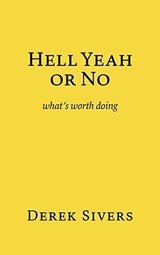
Hell Yeah or No: What's Worth Doing
← Back to Reading List | View Amazon for details and reviews
Summary
Tips for prioritizing what's important in your life. We usually have plenty of time to accomplish whatever we want to, but we are misallocating that time on things that aren't important to us.
Notes and Quotes
He said, "If they really wanted to do it, they would have done it. You've been talking about this new company idea since 2008, but never launched it. Looking at your actions, and knowing you, I'd say that you don't really want to start another company. You actually prefer the simple life you have now, focused on learning, writing, and playing with your kid. No matter what you say, your actions reveal the truth."
Public comments are just feedback on something you made. They're worth reading to see how this thing has been perceived. You can even take it as feedback on the public image you've created. All people know is what you've chosen to show them. So if your public persona is coming across wrong, try tweaking it.
Your time-focus is environmental. People who grow up in unstable places are more present-focused because imagining the future is hard. People who grow up in cold climates are more future-focused because they have to prepare for the winter.
If you're not feeling "Hell yeah, that would be awesome!" about something, say no. It's an easier decision. Say no to almost everything. This starts to free your time and mind.
People say that your first reaction is the most honest, but I disagree. Your first reaction is usually outdated. Either it's an answer you came up with long ago and now use instead of thinking, or it's a knee-jerk emotional response.
Ask myself what's wrong in this very second. Am I in physical pain or danger? No. I've got mental pain, but that's just me imagining things or remembering things. None of it is real.
Observe now. Act later. When I'm feeling cloudy, my decisions and actions will be cloudy too. So I wait a few days before acting on anything. I watch the emotions pass by like a thunderstorm. And the longer I wait, the smarter I get.
Raise standards. Say no to anything less than great. When I'm down, I avoid anyone who doesn't rejuvenate me. They're not allowed in my life right now, not even for a minute. No big explanation needed. No compromise. No favors.
Focus on my goal. The empty space from #3 helps me remember what I'm really doing with my life. Creating, learning, improving, whatever. It's the ten-year-plan type of stuff. Clearing the clutter helps me see the horizon. It's a huge energy-filled feeling of "Oh yeah! That's where I'm going! I had forgotten! I can see it now! Let's go!"
Do all the necessary stuff. When I'm upset, I don't feel like doing anything but wallowing in it. But despite feeling that way, I brush my teeth, make healthy meals, take the kid out to play, do the dishes, pay the bills, take my vitamins, clean up, and go to bed early. These tasks are so mundane, but they help me to feel on top of things. When everyday responsibilities are done, my mind is less distracted.
He taught me that "the standard pace is for chumps"—that the system is designed so anyone can keep up. If you're more driven than most people, you can do way more than anyone expects. And this principle applies to all of life, not just school.
You get no competitive edge from consuming the same stuff everyone else is consuming. It's rare, now, to focus. And it gives such better rewards.
Like everyone, I get those times when I'm unmotivated to do anything. Brain dead. No energy. Everything feels like, "Why bother? What's the point?" But I've finally figured out what to do with those times. Like everyone, I have a list of boring chores that need to be done but that I've been putting off for years. I never do them because I'm always more excited about something else. During my last unmotivated funk, I realized that because nothing is exciting me, that means nothing is exciting me more than this boring necessary stuff. And since I don't want to waste my inspired times on brainless work, this is a perfect time to do those dull tasks.
Instead of comparing up to the next-higher situation, compare down to the next-lower one. For example, if you aim to buy "the best" thing, you may feel like gold when you get it, but when the new "best" thing comes out next year, you'll feel that silver envy. Instead, if you aim to buy the "good enough" thing, it will keep you in the bronze mindset. Since you're not comparing to the best, you'll feel no need to keep up. I've met a lot of famous musicians. The miserable ones were upset that they weren't more famous, because they'd bitterly compare themselves to the superstars. The happiest ones were thrilled to be able to make a living making music.
If we hate doing something, we think of it as hard. We picture it having many annoying steps. If we love doing something, it seems simple. We think of it as one fun step.
Even if you say you want to do something, if you catch yourself thinking of it in many tedious steps, maybe you don't really want to do it. Why would you? It sounds awful. People often ask me about starting my company. "It must have been so difficult! That's a huge undertaking! How did you manage all of that?" But I just answer honestly, "There was really nothing to it. I just made this little website, and people liked it. That's it." I barely even remember the details. In my head it was just one fun step. Now I have to pay attention to that, with each new project I start. How many steps am I picturing?
Do you have a list of conditions you need to have met before you do something? Try changing "and" to "or."
So I decided to gamble on the opposite. Now I just assume I'm below average. It serves me well. I listen more. I ask a lot of questions. I've stopped thinking others are stupid. I assume most people are smarter than me. To assume you're below average is to admit you're still learning. You focus on what you need to improve, not your past accomplishments. Many people are so worried about looking good that they never do anything great. Many people are so worried about doing something great that they never do anything at all. You destroy that paralysis when you think of yourself as just a student, and your current actions as just practice.
Time really is limited. We can't pretend it's not. Time spent doing one thing is time spent not doing something else. It's so easy to waste time doing stuff that's not important, not really fun, and not useful to anyone, not even yourself.
John Cage said, "I can't understand why people are frightened of new ideas. I'm frightened of the old ones."
Alvin Toffler said, "The illiterates of the 21st century will not be those who cannot read and write but those who cannot learn, unlearn, and relearn."
Being smart means thinking things through. It means trying to find the real answer, not the easiest answer. Being stupid means avoiding thinking by jumping to conclusions. Jumping to a conclusion is like quitting a game. You lose by default.
Don't focus on the example itself. Use it as a metaphor, and apply the lesson to my situation. It sounds obvious now, but I'd never looked at it that way before. I realized I could advance my music career by reading books that make no mention of music. In fact, I'd have a competitive advantage by doing so, since most musicians won't!
Judge a goal by how well it changes your actions in the present moment. A bad goal makes you say, "I want to do that some day." A great goal makes you take action immediately.
A bad goal makes you say, "I'm not sure how to start." With a great goal, you know exactly what needs to be done next.
Whatever scares you, go do it.