
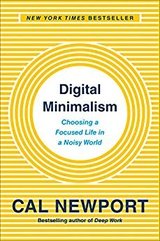
Digital Minimalism: Choosing a Focused Life in a Noisy World
← Back to Reading List | View Amazon for details and reviews
Summary
Realize how dopamine-driven apps negatively impact your work and mental health.
Notes and Quotes
No one app is particularly bad, all apps/distractions together are exhausting.
The urge to check Twitter or refresh Reddit becomes a nervous twitch that shatters uninterrupted time into shards too small to support the presence necessary for an intentional life.
People want to benefit from the positive aspects of these apps without having them consume all of their free time.
However, app makers' goal is to consume your free time (they sell ads and metrics)
The "perceived utility" of social media apps is much higher than it actually is.
Social media apps are a slot machine - Tristan Harris. You open them to see if you won anything (Likes, comments, etc…) and then keep checking to see if you "won".
Pigeon pecking experiment - pigeons love pecking a button that randomly releases food. "Rewards delivered unpredictably are far more enticing than those rewarded with a known pattern."
Checking to see if someone "liked" your posts creates this gambling sensation that releases dopamine. It's unpredictably rewarding and addicting.
Same occurs on news sites - will this article link be a good read? Probably not. But let me open more tab to see if I can hit a jackpot and read something interesting…
You can get people to use your product if you can occasionally give them a dopamine hit through unpredictable rewards.
In addition to unpredictable rewards, the Like button provides social approval, something the vast majority of people need since we are social creatures.
Leah Pearlmann, product manager on the team that created the Facebook Like button, hires someone to do social media for her business so she isn't manipulated.
This unpredictable and social acceptance reward system creates behavioral addictions.
Rules for using technology/Digital Minimalism. This needs to be your personal philosophy that drives all decisions: 1. If technology only provides small benefit, don't use it. 2. Is this technology the best way to use technology to achieve the result you want?
Most users of social media apps have fear of missing out on something good (although these possible benefits are smalls). Digital minimalists have a fear of missing out on known good things with large benefits/big impact.
3 Principles of Digital Minimalism:
-
Clutter is costly - Thoreau in Walden: "The cost of a thing is the amount of what I will call life which is required to be exchanged for it, immediately or in the long run." - Thoreau's new economics says marginal benefit gained usually isn't worth the extra work/stress - Twitter is good. Facebook is good. But if you spend 10 hrs/week to get 1 hour of value, the clutter and additional work those apps create isn't worth it.
-
Optimization is important - Law of diminishing returns states that there is a lot of gain from initially optimizing your process. - eg. Only watch Netflix with friends to prevent binging.
- Uninstall social media apps on phone and only access them on a computer. This allows you to receive the high value benefit without making it a habit to fill up time.
-
Intentionality is satisfying - The Amish aren't anti-technology: they are intentional. They start with their values and then determine if a particular technology is beneficial or detrimental. - "The Amish prioritize the benefits generated by acting intentionally about technology over the benefits lost from the technologies they decide not to use." - "Intention trumps convenience"
When determining whether to keep using a technology, you must answer "Yes" to the following three questions: 1. "Does this technology directly support something that I deeply value?" 2. "Is this technology the best way to support this value?" 3. "How am I going to use this technology going forward to maximize its value and minimize its harm?"
everyone benefits from periods of solitude. Your brain needs alone time to come up with monumental ideas.
“Solitude” doesn’t mean being alone; it means having thoughts to yourself and not having other people’s’ (apps’) thoughts interrupting you.
Digital distractions break solitude.
Quick glances at phones threaten solitude altogether.
“Solitude Deprivation”: never having time alone with your own thoughts.
You can’t “…clarify hard problems,… regulate your emotions, …build courage, … [and] strengthen relationships” if you don’t get solitude.
There has been a spike in mental health issues due to constant phone use.
The first generation of kids born after 1995 (grew up with phones and tablets) show significantly higher mental health issues, especially anxiety, because they never have solitude to deal with their emotions properly.
Schedule long walks during the work day for thinking, preferably somewhere scenic. No phone, no headphones, etc.
When struggling through a problem, write a letter to yourself. This is similar to rubber duck debugging, but potentially better for bigger problems since it slows down your thinking and slows you to truly process it.
Conversations are good. Connection is fine for coordinating(eg. Texts or Facebook for events) but it’s not a replacement for conversation.
Set up office hours to just chat. Either go to a café, or ask people to “call me back at 3:15” (which would be during my commute).
“People crave real conversation” but you have to make an effort because texting is such a lower barrier.